Publications
Employee experience – at the heart of the renewing working life?
The author of the article: Jenna Pennanen, Laurea Journal 24.4.2026
The article delves into the meanings of the concepts of employee experience, employee understanding and employee-centricity in the context of hybrid work and opens up their connection to the well-being of work communities and the competitiveness of the organization. The changing world of work challenges organizations to renew. The article is based on research evidence that positive employee experience increases employee well-being, commitment and performance and strengthens the organization’s productivity and sustainable profitability, especially in the context of hybrid work.
Read the full article (in Finnish)
Inclusive leadership in remote and hybrid work – what is it about?
The author of the article: Siiri Jalo, Laurea Journal 14.4.2026
The article explains what participatory and inclusive leadership mean in practice and why they are key factors in building a well-functioning and healthy work community. Leadership has a direct impact on whether employees feel heard, valued and included, and consequently on engagement, collaboration, and knowledge sharing. The article provides a research-based perspective on how participation, interaction, and trust can be built in digital work environments. In addition, it highlights how leadership practices can strengthen team effectiveness in hybrid work
Read the full article (in Finnish)
Employee‑Centric Organization – What Does It Mean and Why Does It Matter?
The author of the article: Minna Pietikäinen, Laurea Journal 25.3.2026
This article explores why employee‑centricity has become a strategic competitive advantage and how hybrid work is reshaping leadership and workplace dynamics. It brings together research on how empowerment, commitment, and enablement contribute to improved organizational performance. The article also highlights how employee participation and bottom‑up development enhance innovation and wellbeing. In addition, it presents the Dilec project, which studies and develops employee‑centric practices for hybrid work environments.
blog
The training prepared by the Dilec project for companies creates a more inclusive working life
8/2026
Over the past six months, the researchers of the Dilec project have built training for the companies involved in the project, which strengthens and increases the participatory development and leadership skills of their personnel. Now the iterative planning and creation of the training is in its final stages, and the training for development-oriented people is almost complete. The training must be completed independently, but at the same time it involves a lot of other employees in the development. The needs of companies have been listened to from the very beginning in the planning of the training, the preparation of its phases and the instructions for completing it. Particular attention has been paid to the guidelines for development management and the facilitation of development work.
What?
The training has been built on the Canvas learning environment, and the contact persons of the companies have been informed of the content of the training from the beginning of its preparation. In addition, the contact persons of the companies have been helped in marketing the training internally in their companies. The Dilec project collects research data from those who have completed the training. This information will be utilised, for example, in the formulation of an indicative workbook to support employee-centred, digital and participatory leadership and development.
The training includes an orientation part that provides precise step-by-step instructions for completing the training and guides you to employee-centered development work and how to lead it participatory. The theoretical part of the training takes the participants to participatory development, whether they choose to collect experience data from their company’s employees or jump directly into brainstorming solutions to solve a selected development challenge.
Why?
The purpose of the training is to strengthen and grow the participatory leadership competence of those who carry out it, and to ensure that companies benefit from the experimental development work carried out during the training related to the collection and compilation of employee experience data or employee-centred ideation and the new solutions it produces. Through empirical and self-reflective information obtained from those who have completed the training, the project will enable the compilation of realistic solutions for development practices and management for Finnish companies.
When?
The companies involved in the project will have access to the training in September 2026. They have until the end of 2026 to complete the training and carry out practical participatory development work. The training includes theory of participatory leadership in the context of hybrid work, its effects on employee well-being and productivity, and the principles and practices of continuous experimental development. In addition, the programme opens up service design and its methods as a structure and pillar of participatory development. The researchers of the Dilec project provide practical support to those completing the training at pre-agreed times.
Both the researchers of the Dilec project and the representatives of the companies are looking forward to the launch of the training and the new phase of research data collection it will launch in the project
The training prepared by the Dilec project will be available to the companies involved in the project from September 2026 onwards. (Photo: Dilec project brandboard)
The first steps and shared insights of the research work of the Dilec project
2/2026
Since the launch of the Dilec project, its researchers have spent the past six months extensively studying research related to participatory development and leadership. At the same time, it has examined employee-centered operating methods that enable organizations to strengthen their innovation capacity, improve their performance and promote the well-being of their personnel. Based on these theoretical observations, a comprehensive set of articles is currently being prepared.
Interviews and survey
At the turn of the year, a research interview was conducted with the people in management positions of the companies involved in the project using the method of semi-structured thematic interviews. The interviews provided up-to-date information on the companies’ ways of involving their employees in everyday work, as well as in various meetings and development activities. The interviews examined how employees’ ideas and thoughts are expressed or how they affect decision-making in companies. The managers’ responses emphasized the view that decision-making is not an individual performance but is built on cooperation.
The interviews were followed by an extensive personnel survey consisting of six sections. According to the preliminary results of the survey, the opinions of the personnel are listened to and ideas are discussed, but there is still room for improvement in making their progress visible. The interviews and the survey also asked about practices of participatory leadership, which, according to the companies’ responses, stem from factors such as trust, openness, and the sharing of responsibility. The discussion culture of the companies participating in the study was mainly described as open, and the discussions were found to take place through multiple channels. Digital tools were estimated to be used as meeting platforms, but less in process-based business development.
Seminar
The preliminary results of the interviews and the survey were presented at a seminar organized for the project’s companies at the end of February. The participants were able to ask more detailed questions and discuss the observations immediately after the presentation. A digital Padlet platform was also opened for comments. The seminar speakers discussed the importance of employee experience for well-being and commitment, the role of employee-centricity in organizational development, and the connection between participatory leadership and improved performance. The themes were considered both topical and important for the quality of working life.
The seminar also dealt with the transfer of knowledge from more experienced employees to younger ones. The theme was examined in the light of both literature and the preliminary results of the Dilec project survey. The responses show that shared data repositories support knowledge transfer, but on the other hand, the overload and fragmentation of data channels can make it difficult to find information and ensure the consistency of its transfer.
Inspired by the seminar, company representatives pondered, for example, how the culture of sharing tacit knowledge could be strengthened and how employees who work remotely in particular could be made visible in the work community as individuals – not just through their performance. As appreciation has been found to increase efficiency, the participants also discussed ways to strengthen the appreciation experienced by employees. In the era of hybrid work, this kind of consideration is particularly important for organizations to develop competitiveness.
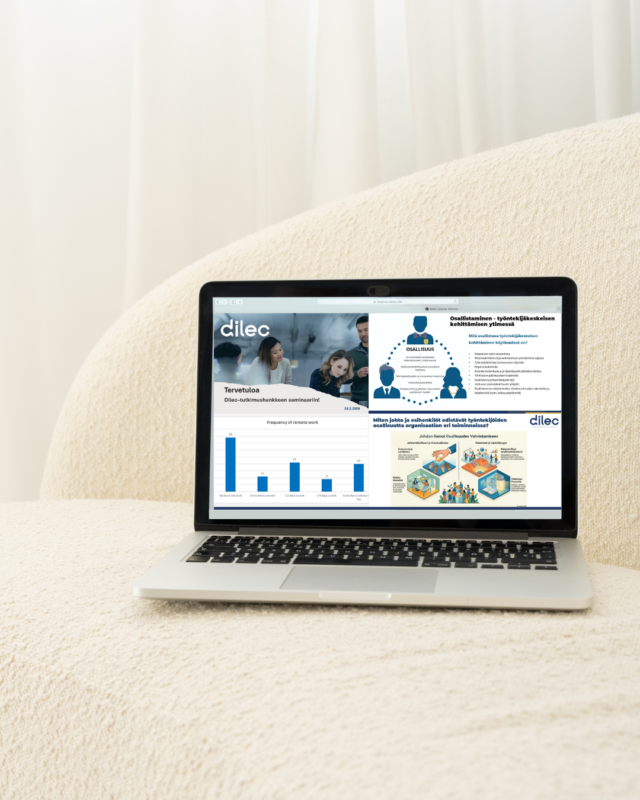
The first seminar of the Dilec project was organised for the companies involved in the project in Teams in February 2026. (Picture: Jenna Pennanen)
Dilec project Kickoff
9/2025
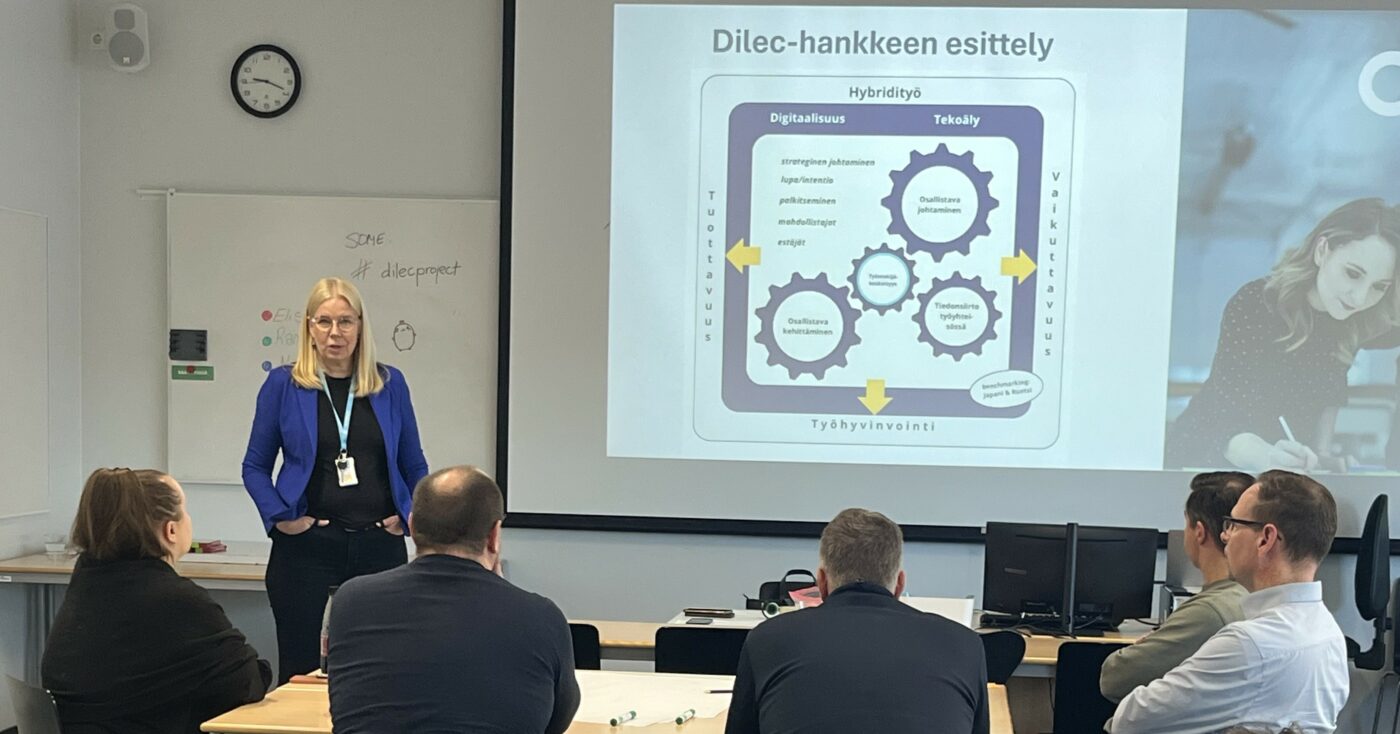
DILEC Project Manager Minna Pietikäinen presents the upcoming content of the DILEC project to company representatives during the project’s first workshop organized for businesses. (Picture: Siiri Jalo)
The Dilec research explores practical methods for digital inclusive leadership and employee-centered career path development, including knowledge transfer using AI solutions. It also studies the impact of these approaches on work quality, operational efficiency, and business productivity.
Digital Transformation and Employee-Centricity
Digital transformation requires companies to balance technological advancements with employee experience. The project provides companies with best practices for inclusive leadership and employee-centered career path development, helping them improve leadership and processes. When employees participate in developing work and career processes, the solutions become more effective and widely accepted.
Impact on Finnish Working Life
The research results promote a more innovative, resilient, and employee-centered working life in Finland. Companies that adopt inclusive leadership and digital employee-centered transformation practices achieve higher productivity and profitability while creating workplaces where employees thrive, participate, and commit to long-term success.
Project Launchin September 2025
We launched the DILEC project together with companies in September 2025. Our first research task is to understand what digital and AI tools companies use for leadership and process development, and how employee participation is realized in everyday teamwork and work development. We use workshops, interviews, and surveys to understand company practices. Based on the collected data, we can better target the research and support companies in their digital transformation.
Companies are enthusiastically participating in the joint research, and we look forward to fruitful research years from 2025 to 2028.

 Suomi
Suomi